Deck Repair Calgary: What Needs Fixing Now
By Vitalii Nestorenko · June 22, 2026 · 7 min read
A deck rarely fails all at once. More often, it starts with a loose railing that wobbles when you lean on it, a few soft boards near the stairs, or fasteners that keep pushing up after every freeze-thaw cycle. That is usually how deck repair Calgary homeowners deal with begins - small warning signs that turn into bigger, more expensive problems if they sit through another season.
In Calgary, decks take a beating. Snow loads, dry summers, sudden temperature swings, moisture trapped around fasteners, and UV exposure all work against wood and composite surfaces over time. If your deck feels less solid than it used to, looks uneven, or has visible wear around the stairs, ledger, posts, or railings, it is worth addressing now instead of waiting for peak patio season.
When deck repair in Calgary is the right call
Not every aging deck needs to be rebuilt. In many cases, a focused repair can restore safety, improve appearance, and buy you more life from the structure without the cost of starting over.
That usually makes sense when the main framing is still sound but a few components have worn out faster than the rest. Surface boards can crack, cup, or rot before joists fail. Railings can loosen even when the deck base remains solid. Stairs often show damage earlier because they handle concentrated foot traffic, standing water, and snow shovelling.
A practical repair is often the right move if the issues are localized, the deck still feels structurally stable overall, and the damaged areas can be replaced without opening up a chain reaction of hidden failures. If the framing is compromised in multiple areas, or if the deck was built poorly to begin with, repair can become a short-term patch rather than a smart investment. This is where an honest assessment matters.
The signs your deck should not wait
Some deck issues are cosmetic. Others are safety problems.
If a board has minor surface checking or faded stain, that may not be urgent. But if boards feel soft underfoot, flex too much, split across the grain, or have fasteners pulling loose, you are past the stage of simple upkeep. The same goes for railings that move, stair treads that tilt, and posts that show signs of rot where they meet concrete or sit near grade.
Pay close attention to the ledger board, which is the point where the deck connects to the house. If that connection is loose, improperly flashed, or water-damaged, the problem is more serious than a few bad deck boards. You may also notice sagging between supports, joists with visible rot, or metal connectors that are rusting through. Those are not details to ignore.
Common deck repair Calgary homeowners ask for
Most repair calls are not about one dramatic failure. They are about a handful of problems that make the whole deck feel tired, unsafe, or overdue for attention.
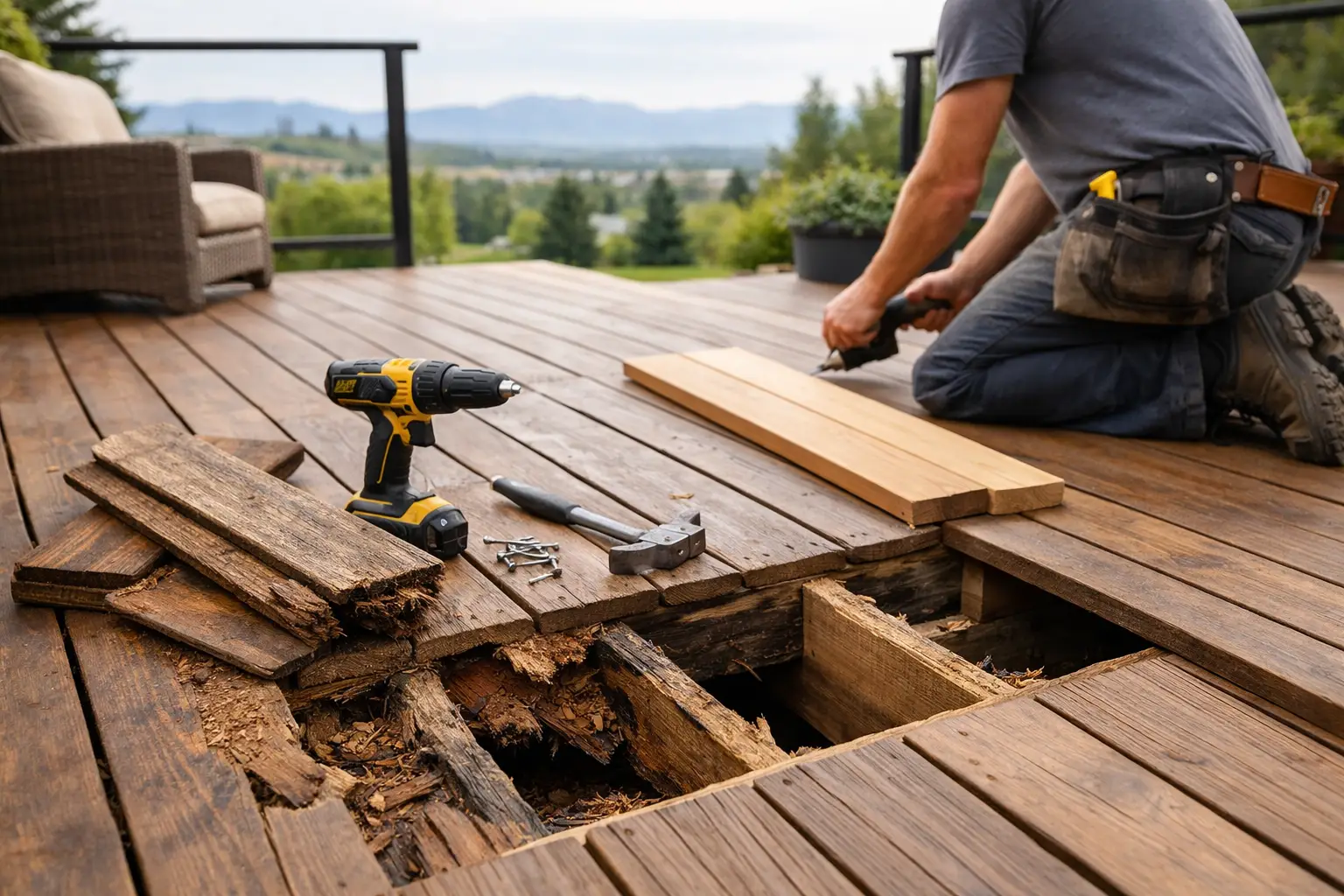
Surface board replacement is one of the most common fixes. Boards crack, warp, or rot, especially in spots where water sits or snow piles up. Replacing selected boards can tighten up the walking surface and improve the look of the entire deck.
Railing repair is another frequent need. A loose handrail or guardrail is more than an annoyance, especially if children, guests, or tenants use the space. Railings can loosen at connection points, posts can shift, and wood can split around screws or bolts.
Stair repair comes up often as well. Treads, risers, stringers, and handrails wear unevenly, and stairs tend to show movement before the main deck does. If the stairs bounce, lean, or feel uneven, they should be repaired before someone gets hurt.
There are also framing and support issues that require a closer look. That can include damaged joists, failing post bases, loose hardware, or sections that have settled over time. These repairs matter most because they affect the structure, not just the finish.
What Calgary weather does to a deck
Decks here live through conditions that are hard on every joint and material. Freeze-thaw cycles force moisture into tiny cracks, then expand them. Snow sits against horizontal surfaces and melts slowly. Chinooks can create rapid swings that dry one area while leaving another damp. Summer sun fades finishes and dries wood unevenly, which can lead to splitting and movement.
That means even a deck that looked fine last year can change quickly. A small soft spot may spread. Hardware can loosen. Water can work into end cuts, fastener holes, and connection points.
It also means repair decisions should be practical, not purely cosmetic. A fresh coat of stain will not solve hidden rot. On the other hand, replacing every visible board is not always necessary if the problem is isolated to a few sections. Good repair work starts with finding the actual source of the damage.
Repair or replace? It depends on the structure
This is the question most homeowners really want answered. And the honest answer is that it depends on what is underneath.
If the frame is in good shape and the damage is mostly on the surface, repair is usually the better value. You can replace bad boards, tighten railings, fix stairs, and address trouble spots without paying for a full rebuild.
If the deck has widespread rot, poor structural support, major movement, or repeated patch jobs over the years, replacement may be the smarter long-term decision. Spending money on cosmetic repairs when the framing is already failing does not save you anything.
Age matters, but not as much as condition. A well-built deck with some worn boards may have plenty of life left. A newer deck built with weak connections, poor flashing, or bad drainage can need structural work much sooner than expected.
Why small repairs save bigger money
The biggest cost driver is usually not the first damaged board. It is the damage that spreads because the first issue was ignored.
A single cracked board can let in more water. A loose railing can stress the post and connection point. One bad stair tread can lead to movement in the stairs below it. Moisture around fasteners can gradually affect nearby boards and framing.
That is why timely repair matters. You are not just fixing what looks wrong today. You are stopping the next round of damage before it starts. For busy homeowners, landlords, and anyone managing a rental property, that is often the difference between a straightforward service call and a much larger project later.
What a professional deck repair should include
A proper repair is more than swapping out the most obvious damaged piece.
The deck should be checked as a system - surface boards, framing, stairs, railings, hardware, and connection points. Repairs need to match the condition of the structure, not just improve the appearance from the top. If a railing is loose because the post connection has failed, tightening the top rail alone will not solve the real problem.
Work should also be clean and practical. Homeowners want the deck safe, solid, and usable again without a drawn-out process or a mess left behind. That is especially true when the repair is one item on a longer household to-do list. This is where working with a reliable handyman service can make sense, particularly for smaller-to-medium deck and stair repairs that need prompt attention without the hassle of coordinating multiple trades.
Choosing the right help for deck repair in Calgary
When you hire someone to work on an exterior structure, trust matters. You want clear communication, realistic advice, and workmanship that holds up. That means no vague promises, no pushing a full rebuild when a repair will do, and no patching over safety issues to make the estimate look cheaper.
Look for someone who treats the job with the same care they would use at their own home - checking the details, protecting the area, and being honest about what can and cannot be fixed. If the repair is straightforward, you should hear that. If there is more going on underneath, you should hear that too.
For many households, the real value is speed and accountability. If your deck is unsafe, you do not want to spend weeks chasing quotes for a modest repair. You want a dependable professional who shows up, explains the issue clearly, and gets it handled properly. That is the standard businesses like Nestor's Home Help aim to meet.
The best time to fix a deck
The best time is before the damage spreads and before the deck is in constant use. Spring and early summer are common, but there is real value in tackling repairs as soon as problems show up, even if the deck is not your top seasonal priority.
A solid deck makes daily life easier. It keeps the backyard usable, makes stairs safer, and takes one more unfinished project off your mind. If your deck is telling you something feels off, it is usually right. Getting it repaired now is often the simplest way to protect both your home and your peace of mind.
Vitalii Nestorenko is the owner of Nestor's Home Help, a licensed and insured handyman business in Calgary. He holds a Master's degree in mechanical engineering and does every job himself.